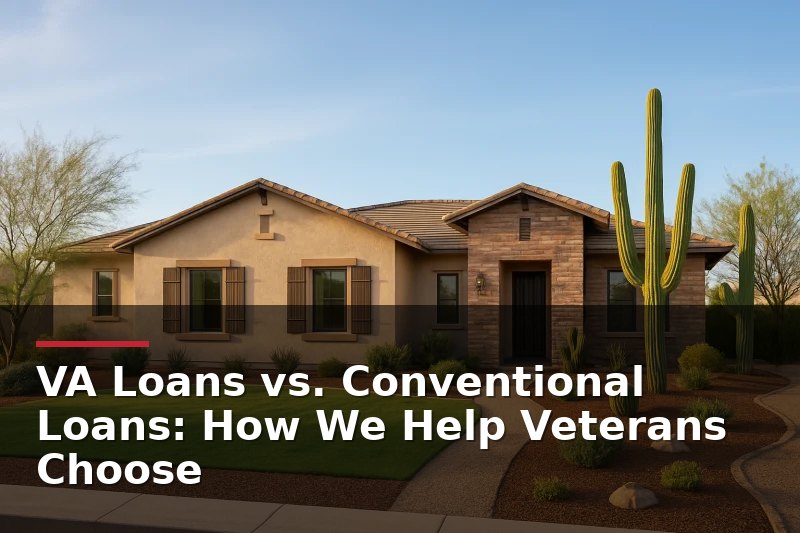
Buying a higher-priced home with a VA loan can feel uncertain because conventional loan limits…

VA Loans vs. Conventional Loans: Compare Options
Veterans often know they have earned access to VA financing, but deciding whether it is the right choice can still feel complicated.
VA loans can offer eligible borrowers zero-down financing without monthly mortgage insurance, while conventional loans may provide more flexibility for property type, occupancy, and future financing goals.
In this guide, we explain the major differences, costs, qualification factors, and questions veterans should consider before choosing a mortgage.
Key Takeaways
- Eligibility: VA loans require qualifying military service or another eligible VA status, while conventional loans do not have a military-service requirement.
- Down Payment: Eligible VA borrowers may finance a primary residence with 0% down, while some conventional programs begin at 3% down.
- Mortgage Insurance: VA loans do not require monthly mortgage insurance, but conventional loans commonly require private mortgage insurance with less than 20% down.
- Property Use: VA financing is generally for a primary residence, while conventional financing may cover primary homes, second homes, or investment properties.
- Decision: The right option depends on eligibility, cash reserves, credit, property plans, funding-fee status, and the complete cost of each loan.
At America First Mortgage (NMLS# 2564858), we help eligible veterans compare VA and conventional financing using the same purchase price, down payment, estimated payment, and ownership timeline. We are a veteran-owned, Nevada-based mortgage broker serving borrowers in Nevada, Arizona, Colorado, Florida, Idaho, and Texas.
Quick Answers About VA and Conventional Loans
- Which loan can provide 0% down? A VA loan may provide 0% down for an eligible borrower purchasing an acceptable primary residence, subject to entitlement and underwriting.
- Does a VA loan have monthly mortgage insurance? No. VA loans do not require monthly private mortgage insurance, although a one-time VA funding fee may apply unless the borrower is exempt.
- Can conventional financing cover a second home or investment property? Yes. Conventional loans can generally finance eligible second homes and investment properties, although requirements are usually different from primary-residence financing.
- Should veterans choose based only on the interest rate? No. We recommend comparing the rate, annual percentage rate, funding fee, mortgage insurance, cash needed, monthly payment, and long-term cost.
What Is the Main Difference Between VA and Conventional Loans?
A VA loan is a mortgage partially guaranteed by the U.S. Department of Veterans Affairs for eligible borrowers, while a conventional loan is not insured or guaranteed by a federal government agency.
The VA guaranty allows approved lenders to offer features such as no required down payment and no monthly mortgage insurance. Borrowers must still meet applicable credit, income, occupancy, property, and lender requirements.
A conventional mortgage follows guidelines established by the lender, investor, or government-sponsored enterprises when applicable. Conventional loans are available without military service, and they provide broader options for occupancy and property use.
VA Loans vs. Conventional Loans at a Glance
| Feature | VA Loan | Conventional Loan |
|---|---|---|
| Eligibility | Requires eligible military service or another qualifying VA status | No military-service requirement |
| Minimum Down Payment | May be 0% with sufficient entitlement and approval | Some programs allow 3%; requirements vary |
| Monthly Mortgage Insurance | Not required | Commonly required below 20% down |
| Upfront Program Fee | VA funding fee may apply unless exempt | No VA funding fee, although standard closing costs apply |
| Occupancy | Generally requires primary-residence occupancy | Primary, second-home, and investment options may be available |
| Property Review | VA appraisal includes value and minimum property requirements | Appraisal generally focuses on value and property acceptability |
These are general comparisons as of 2026. Rates, fees, underwriting requirements, and program guidelines can change, so borrowers should verify current information for their specific transaction.
When a VA Loan May Be the Stronger Option
A VA loan may deserve close consideration when preserving cash is a priority. The ability to purchase with no required down payment can help an eligible borrower retain funds for closing costs, reserves, moving expenses, repairs, or other financial goals.
No Monthly Mortgage Insurance
VA loans do not require monthly mortgage insurance, regardless of the down payment. This can create an important payment difference compared with a low-down-payment conventional loan that includes private mortgage insurance.
VA loans often have a one-time funding fee instead. The fee varies based on factors such as loan use, down payment, and military category, and certain eligible borrowers are exempt. It can commonly be financed into the loan, but financing it increases the starting balance.
Flexible Underwriting Structure
VA underwriting considers credit, debt obligations, stable qualifying income, and residual income. Residual income is the money expected to remain after major monthly obligations and estimated living expenses are accounted for.
This does not mean approval is automatic or that every property will qualify. The lender must document the borrower’s ability to repay, confirm VA eligibility, and evaluate the complete loan file.
Competitive Primary-Residence Financing
VA financing can work for eligible primary residences in Las Vegas, Henderson, North Las Vegas, Boulder City, and communities such as Cadence, Inspirada, Skye Canyon, and Aliante. It may also be used for eligible properties in other states we serve, subject to occupancy, property, and program guidelines.
For new construction or quick move-in homes, we recommend comparing the builder’s incentives against outside financing. A builder credit or temporary rate buydown may be valuable, but it should be evaluated alongside the loan’s rate, fees, payment, and long-term structure.
When a Conventional Loan May Make More Sense
A veteran is not required to use a VA loan. Conventional financing may be more suitable when its overall structure supports the borrower’s property plans or financial objectives.
You Are Making a Larger Down Payment
A conventional loan may become more competitive when the borrower plans to make a substantial down payment. At 20% down, private mortgage insurance is generally not required. With less than 20% down, mortgage insurance may still be temporary if applicable cancellation requirements are later met.
Some qualified borrowers can use low-down-payment purchase options beginning at 3%. Eligibility and pricing depend on the specific conventional program, credit profile, property, income, and occupancy.
The Property Will Not Be Your Primary Residence
VA loans generally require the home to be occupied as a primary residence. Conventional financing may therefore be the relevant choice for an eligible second home or investment property.
Occupancy must always be represented accurately. A borrower should not apply for primary-residence terms when the actual intent is to use the property as a second home or rental.
You Want to Preserve VA Entitlement
Some veterans choose conventional financing so they can preserve available VA entitlement for another primary-residence purchase. Whether that strategy is beneficial depends on existing VA loans, remaining entitlement, expected relocation plans, and the cost difference between the available options.
The Property Presents VA Eligibility Challenges
VA minimum property requirements focus on whether a home is safe, structurally sound, and sanitary. Conventional loans also have property standards, but the review process can differ.
For condominiums, HOA communities, or properties needing repairs, we review project eligibility and property condition early. Financing should not be selected on the assumption that one appraisal type will overlook a significant condition issue.
How Credit, Income, and Debt Affect the Comparison
Neither VA nor conventional financing relies on a single qualification number. Lenders evaluate the full file, including credit history, qualifying income, current debts, assets, reserves, occupancy, and property details.
Credit Profile
The VA itself does not establish one universal minimum credit score for every lender. Individual lenders may apply their own credit standards. Conventional pricing and mortgage insurance can also be particularly sensitive to credit, down payment, and other risk factors.
Instead of looking only at whether a loan is technically available, we compare how the credit profile affects the actual rate, fees, mortgage insurance, and payment.
Self-Employment Income
Self-employed veterans can potentially qualify for either option, but the lender must document stable, qualifying income. Tax returns, business returns, profit-and-loss statements, balance sheets, and business bank statements may be requested depending on the business structure and loan program.
When standard documentation does not accurately reflect available cash flow, a non-QM option such as a bank statement program may be worth reviewing. That is a separate loan structure and does not carry VA benefits.
Debt-to-Income Ratio and Residual Income
Debt-to-income ratio compares qualifying monthly debts with gross qualifying monthly income. Conventional and VA lenders use this calculation, but VA underwriting also places particular emphasis on residual income.
A higher ratio does not automatically result in approval or denial. Compensating factors, credit history, reserves, income stability, and automated or manual underwriting findings can affect the decision.
How We Compare VA and Conventional Loan Offers
Comparing two loan estimates is more useful than comparing two advertised rates. We recommend reviewing the following items side by side:
- Confirm VA eligibility and entitlement. Obtain the Certificate of Eligibility and identify whether full or remaining entitlement is available.
- Use the same purchase assumptions. Compare the same property price, occupancy, loan term, down payment, and estimated closing date.
- Review total cash needed. Include the down payment, closing costs, prepaid taxes and insurance, credits, and required reserves.
- Compare monthly housing costs. Account for principal, interest, property taxes, homeowners insurance, HOA dues, and mortgage insurance when applicable.
- Evaluate upfront financing costs. Review the VA funding fee, conventional mortgage insurance, discount points, lender fees, and available credits.
- Consider the ownership timeline. A borrower expecting to keep a home for many years may evaluate costs differently from someone anticipating a future move or refinance.
Rates and fees can change with the market, and quotes can differ based on when they are issued. For a meaningful comparison, request estimates at approximately the same time and ask whether the pricing is locked or merely quoted.
Prepare for Pre-Approval Before Making an Offer
A focused pre-approval review can identify documentation needs before a purchase contract introduces deadlines. Veterans should be prepared to provide identification, income records, asset statements, housing history, and authorization for credit review. VA borrowers may also need service-related documents if eligibility cannot be confirmed electronically.
In competitive markets such as Clark County, Phoenix, Denver, Boise, Dallas, or Tampa, preparation can help borrowers submit an offer with a financing strategy already selected. Pre-approval is not a guarantee of final approval; the property, appraisal, title, insurance, and updated borrower information must still satisfy applicable requirements.
Review Your VA and Conventional Options With Us
The right mortgage is not always the program with the smallest down payment or the lowest initial quote. It is the option that appropriately balances cash needed, monthly payment, financing costs, property plans, and long-term goals.
Call, text, or email us to review your scenario, compare VA and conventional options, and understand the next steps. We can also help with pre-approval planning so you know which documents to prepare before shopping for a home.
Frequently Asked Questions
Can a veteran use a VA loan more than once?
Yes. VA loan eligibility can be reused when entitlement is restored, and some borrowers may have enough remaining entitlement to obtain another VA loan. The available amount depends on prior VA loan use, restoration status, location, and the new transaction.
Can someone obtain another VA loan while keeping an existing VA-financed home?
It may be possible when the borrower has remaining entitlement, meets occupancy rules for the new home, and qualifies while carrying both obligations. The lender must calculate available entitlement and determine whether a down payment is required.
Can a VA loan finance a condominium?
Yes, but the condominium project generally must meet current VA eligibility requirements. We recommend checking the project’s status early because project review can affect financing options and the transaction timeline.
How does self-employment affect a veteran’s mortgage application?
Self-employment does not prevent a veteran from applying for VA or conventional financing. The lender will generally review the stability of the business, qualifying income, tax documentation, debts, and the effect of significant business expenses or recent changes.
Does a VA appraisal usually make the closing process longer?
Not necessarily. Timing depends on appraiser availability, property condition, required repairs, documentation, and local market conditions. Starting the appraisal promptly and addressing property questions early can help keep the transaction moving.
This is educational and not financial advice. Loan programs and guidelines can change. Talk with a licensed mortgage professional about your specific scenario.

About the Author
Bill Merren
President & CEO at America First Mortgage · NMLS #196091
Bill, a Las Vegas native, attended Durango High School, where he excelled in athletics and earned an academic scholarship to attend UNLV after serving six years in the U.S. Army. Bill and his wife are active parents, raising their four sons and often spending weekends at various sports fields or enjoying outdoor activities around Vegas
Specializes in: VA loans
Non QM Loans
Reverse Mortgage
Licensed in: AZ, CO, FL, ID, NV, TX
Related Posts